Wandering is one of the most dangerous dementia symptoms families face. Here’s what actually prevents it — and what to have in place before it happens.
Wandering is one of the most frightening things a family managing dementia at home can face. Not because it’s rare — up to 60 percent of people with dementia will wander at some point — but because of what can happen when it does. A person who leaves home without awareness of where they’re going, in any weather, at any time of day or night, without the ability to ask for help or communicate their location, can be in serious danger within minutes.
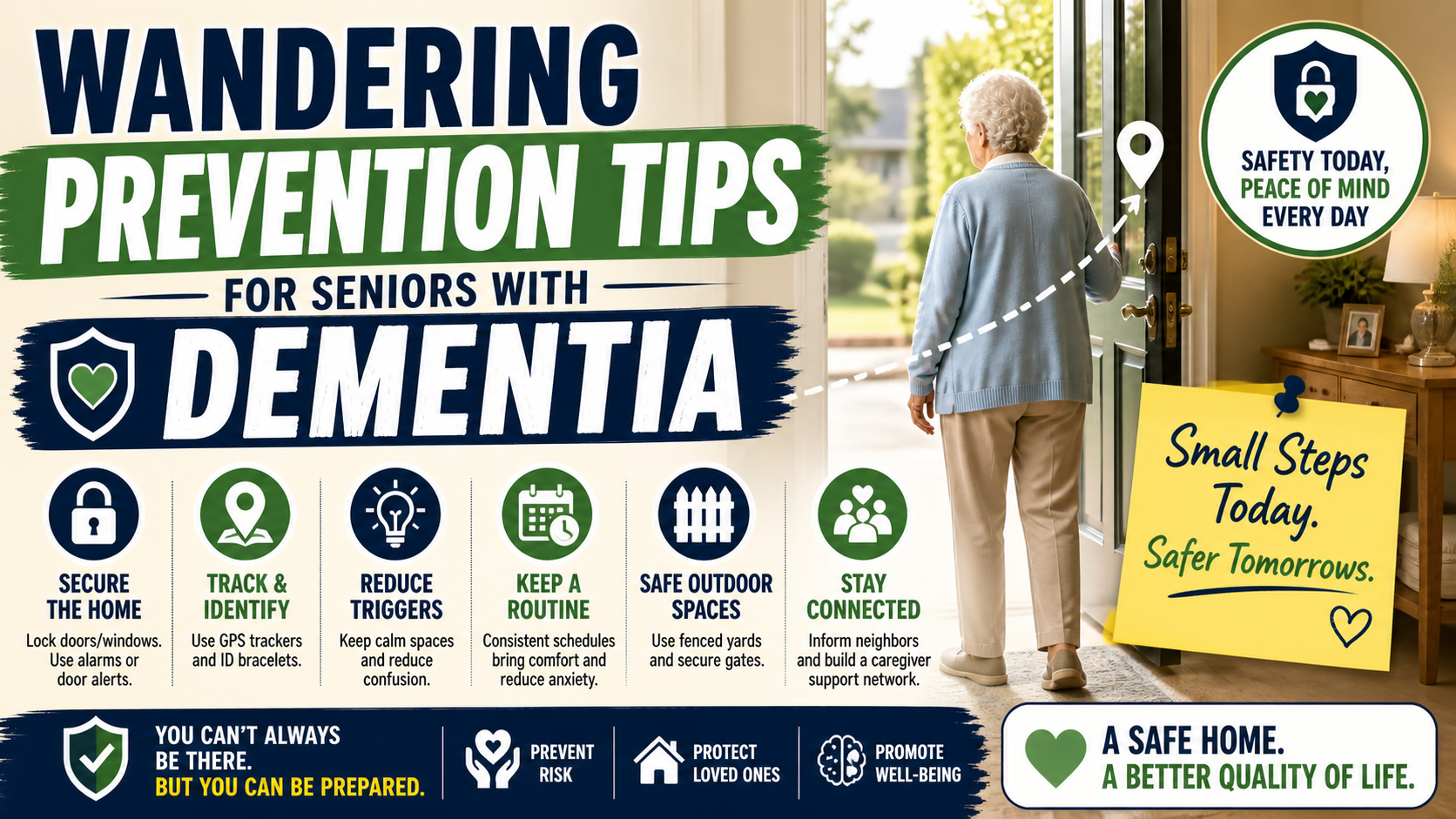
The families who navigate wandering most successfully are the ones who prepare for it before it happens — not after. This guide covers everything worth knowing about why wandering occurs, how to prevent it where possible, how to slow it when prevention isn’t enough, and what to have in place so that when a wandering episode does happen it ends safely.
Why People With Dementia Wander
Understanding why wandering happens makes the prevention strategies more logical and more effective. Wandering in dementia isn’t random — it’s almost always driven by a reason that makes complete sense to the person experiencing it, even when it makes no sense to observers.
Disorientation in Time and Place
The most common cause of wandering is disorientation about where the person is or what time period they’re living in. A person with dementia may wake up convinced they’re late for a job they held 40 years ago, or that they need to pick up children who are now adults, or that they’re in the wrong house and need to go home — even when they are home.
From inside that experience the exit attempt is completely rational. They’re not being difficult or unsafe — they’re responding to a reality that’s completely real to them in that moment.
Unmet Needs
Wandering is frequently driven by an unmet physical or emotional need — hunger, thirst, pain, the need to use the bathroom, boredom, loneliness, or anxiety. When a person with dementia can’t communicate or identify the need directly, the response may be restless movement and eventually an attempt to go somewhere to address a need they can’t articulate.
Addressing basic needs proactively — consistent meals and hydration, regular bathroom trips, meaningful activity during the day, and reassuring social interaction — reduces the frequency of need-driven wandering significantly.
Medication Side Effects

Some medications cause restlessness, agitation, or altered sleep patterns that contribute to nighttime wandering. A medication review specifically asking about restlessness and nighttime behavior — with the physician who manages dementia care — is worth doing if wandering is becoming a pattern. Before assuming behavior changes are caused by dementia alone, families can review medication-related warning signs with the prescribing physician.
Sundowning
Sundowning — the increased confusion and agitation that many people with dementia experience in the late afternoon and evening — is a major driver of nighttime wandering. The cause isn’t fully understood but disruption of the circadian rhythm plays a role. Managing sundowning through consistent daily routines, adequate daytime light exposure, and evening calming activities reduces its severity and the wandering that often accompanies it.
Searching for Familiar People or Places
A person with dementia may wander in search of someone they love who is deceased, a home they lived in decades ago, or a place that represents safety and comfort from earlier in their life. This form of wandering is particularly poignant and particularly difficult to redirect — because the destination the person is seeking doesn’t exist anymore.
The Three-Layer Approach to Wandering Prevention

No single measure prevents wandering completely — dementia is progressive and wandering behavior evolves. The most effective approach uses three layers simultaneously: reducing the triggers that prompt wandering, slowing exit attempts when they occur, and ensuring rapid location when a person does get out. When rapid location is part of the plan, Best GPS Watch for Elderly Parents — Real-Time Tracking That Actually Works explains how GPS tracking and geofencing support that final layer.
Layer 1 — Reduce Triggers
Addressing the underlying causes of wandering reduces its frequency even when it can’t be eliminated entirely.
Establish consistent daily routines. Predictable structure — regular wake time, mealtimes, activity periods, and bedtime — reduces the disorientation that triggers wandering. Routines provide an anchor when internal time orientation is unreliable.
Increase meaningful daytime activity. Boredom and under-stimulation are significant wandering triggers. Structured activity — simple tasks, music, outdoor time, social interaction — reduces restlessness and the impulse to seek stimulation through movement. Physical activity during the day also improves nighttime sleep, reducing nighttime wandering.
Maximize daytime light exposure. Natural light helps regulate the circadian rhythm that sundowning disrupts. Time outside or near bright windows during the day — particularly in the morning — has meaningful evidence for reducing sundowning severity and improving nighttime sleep.
Address pain and discomfort proactively. A person with dementia who is in pain from arthritis, a urinary tract infection, or any other source may not be able to communicate that pain directly. Behavioral changes including increased restlessness and wandering are frequently the primary signal of untreated pain. Regular pain assessment and prompt treatment of any identified infection or discomfort reduces this trigger directly.
Use reassurance and redirection. When a person expresses a desire to go somewhere — to work, to their childhood home, to find a deceased family member — direct contradiction rarely helps and often increases agitation. Acknowledge the feeling behind the need: “You want to get home — that makes sense. Let me sit with you for a minute.” Then redirect to something comforting. This approach doesn’t always work but is significantly more effective than arguing about reality.
Layer 2 — Slow Exit Attempts
When a person with dementia is determined to leave, the goal shifts from prevention to delay — buying enough time for a caregiver to respond before the person reaches the street or a dangerous area.
Door alarms. A simple chime or alarm that sounds when an exterior door is opened gives caregivers immediate notification of an exit attempt — particularly valuable at night when the caregiver may be asleep. Wireless door alarms that alert a caregiver’s phone or a bedroom chime are widely available and inexpensive. Install on all exterior doors including garage access doors.
Visual deterrents. Several visual modifications exploit the perceptual changes of dementia to discourage exit attempts without physical restraint:
- A full-length mirror on the back of the exit door — many people with dementia will not approach what appears to be another person
- A dark floor mat in front of the door — often perceived as a hole or obstacle that the person won’t step over
- A curtain covering the door — if it doesn’t look like a door it may not be recognized as an exit
- Stop sign or “do not enter” signage at eye level — some people respond to familiar authority signals even with significant cognitive impairment
Door knob covers and high locks. Door knob covers that require specific grip to turn — difficult for someone with dementia to manage — slow exit attempts. A deadbolt positioned high on the door frame — above typical eye level for a person with dementia — may not be noticed or attempted. The goal is delay, not permanent prevention.
Disguise exit doors. Painting the door the same color as the surrounding wall, covering it with a bookcase or curtain, or adding a mural that makes it blend into the wall can prevent the door from being recognized as an exit at all.
Enclosed outdoor spaces. A securely fenced backyard that a person with dementia can access freely provides safe outdoor movement without exit risk. This can significantly reduce wandering driven by the need for outdoor stimulation and physical movement — the person gets the experience of going outside without the danger of leaving the property.
Layer 3 — Ensure Rapid Location
Even with layers one and two in place, wandering episodes will occur in some people with dementia. The third layer is ensuring that when a person does get out, they’re found quickly — before exposure, traffic, or disorientation puts them in serious danger.
GPS tracking is the most important tool in this layer.

The SecuLife Smartwatch provides real-time GPS location through the SecuPro companion app — family members can see exactly where their loved one is at any moment, from any location, on their smartphone. When a wandering episode occurs the person’s location is immediately visible rather than requiring a search.

The geofencing feature is particularly valuable for proactive management. Set a geographic boundary around the home — or any safe area — and receive an immediate alert on your phone when the boundary is crossed. This alert can come before the person has walked more than a block, allowing rapid response before the situation becomes dangerous. Families considering a wearable that combines location alerts with fall protection can consult this senior safety smartwatch guide.

Two-way calling through the watch means family members can speak directly with their loved one through the device — providing reassurance, orienting them, and potentially talking them through returning home — even when they can’t communicate their location verbally. The same watch safety features can also matter when families are comparing devices for everyday independent living.
The watch format matters for dementia specifically. A device that a person with dementia will accept wearing consistently is far more valuable than a more capable device they refuse. The SecuLife looks like a regular watch — familiar, unremarkable, and much more likely to be worn without protest than something that looks like medical equipment.

Our full SecuLife Smartwatch review covers every feature in detail including GPS accuracy and geofencing configuration.
→ See the SecuLife Smartwatch on Amazon — GPS tracking and geofencing for dementia wandering
Nighttime Wandering — Special Considerations
Nighttime wandering is particularly dangerous — it happens in darkness, when the caregiver may be asleep, and when the person with dementia is at their most disoriented. Several specific measures address the nighttime wandering risk beyond what’s covered above.
Lighting
Adequate nighttime lighting reduces the disorientation of waking in darkness — which can trigger the confused thinking that prompts a wandering attempt. Plug-in auto-on night lights in the bedroom, hallway, and bathroom activate automatically and ensure the person wakes into a lit environment rather than complete darkness.

The Energizer Auto-On rechargeable flashlights cover all three key locations in one purchase — staying charged continuously and activating automatically when needed including during power outages.

→ Get the Energizer Auto-On 3-Pack on Amazon
Bed Alarms
A bed alarm — a pressure-sensitive pad under the mattress that alerts when weight is removed — notifies caregivers the moment a person gets out of bed. This is the earliest possible alert for nighttime wandering, before the person has reached a door or navigated out of the bedroom. Combined with a door alarm, bed alarms create a two-stage alert system that gives caregivers maximum response time.
Bedroom Door Alarms
An alarm on the bedroom door itself — in addition to exterior doors — provides an intermediate alert point for nighttime wandering. By the time a person with dementia has left the bedroom they may already be confused and moving quickly. A bedroom door alarm alerts the caregiver earlier in the sequence.
Addressing Sundowning
Nighttime wandering driven by sundowning responds to consistent management of the sundowning pattern itself. A consistent evening routine — calming activity, low stimulation, familiar music, reduced light — helps signal the transition to nighttime. Some people benefit from brief light exercise in the late afternoon to reduce evening restlessness. Discuss sundowning management specifically with the physician managing dementia care — there are both behavioral and medical approaches worth exploring.
Having an Emergency Plan
Every family managing dementia at home should have a specific emergency plan for a wandering episode — developed before one occurs, not in the middle of one.
Register with local emergency services. Many police departments and sheriff’s offices have voluntary registries for people with dementia or other conditions that create wandering risk. Registration means that if you call to report a missing person with dementia, first responders already have a photo, physical description, GPS device information, and known destinations or habits on file. This dramatically speeds response time.
Have current photos ready. Keep recent photos of your loved one — front and side, showing what they typically wear — readily accessible on your phone. You’ll need them immediately if you report a missing person.
Know the GPS device information. Know how to access the GPS app, what the current location looks like, and how to share location with emergency services. Practice using the app before you need it under stress.
Know the likely destinations. People with dementia who wander often go toward places that were significant earlier in their life — a childhood home, a workplace, a church, a family member’s house. Knowing these locations and checking them early in a search significantly improves the speed of location.
Have emergency contacts ready. A list of neighbors, family members, and friends who can help search — with phone numbers — should be ready to activate immediately. Searches that begin within minutes of a wandering episode are dramatically more successful than those that begin after a delay.
The Caregiver Reality
Managing wandering risk is exhausting. The hypervigilance required — particularly for nighttime wandering — takes a significant toll on caregivers over time. It’s worth acknowledging honestly that the strategies in this guide reduce risk but don’t eliminate the need for ongoing vigilance, and that sustained vigilance without support leads to caregiver burnout that ultimately compromises the safety of the person being cared for. When exhaustion affects the older adult rather than the caregiver, understanding persistent exhaustion in seniors provides a helpful framework for considering possible causes.
Respite care — scheduled breaks from caregiving — is not a luxury for families managing wandering. It’s a necessity for sustainable caregiving. Local Area Agencies on Aging, the Alzheimer’s Association helpline (1-800-272-3900), and community dementia care programs all offer caregiver support and respite resources worth contacting.

For the broader picture of keeping someone with dementia safe at home our guide on home safety tips for seniors with dementia covers every room and every major risk category. And for families navigating the full range of senior safety decisions our guides on warning signs a senior may not be safe living alone and how to talk to a parent about safety measures cover the conversations and decisions that surround this one.
Wandering Prevention Checklist
- GPS tracking device in use — geofencing configured for home boundary
- Door alarms on all exterior doors
- Bedroom door alarm installed
- Bed alarm in place for nighttime monitoring
- Visual deterrents on primary exit doors
- High locks or door knob covers on exterior doors
- Consistent daily routine established
- Meaningful daytime activity scheduled
- Sundowning management plan in place
- Night lights in bedroom, hallway, and bathroom
- Registered with local police wandering registry
- Current photos of loved one accessible on phone
- Known likely destinations identified and documented
- Emergency contact list ready to activate
- Caregiver respite plan in place
Frequently Asked Questions
At what stage of dementia does wandering typically begin?
Wandering most commonly emerges in the middle stage of dementia — when disorientation is significant but the person still has enough physical mobility and initiative to act on confused thinking. However it can occur at any stage and the timing varies significantly between individuals. Having GPS tracking and door alarms in place from early in the diagnosis means the infrastructure is already there when behavior changes rather than needing to be implemented reactively after a first episode.
Is it legal to use GPS tracking on someone with dementia?
In most jurisdictions GPS tracking of a family member for safety purposes is legally permissible, particularly when the person has dementia and a designated caregiver or legal guardian is responsible for their safety. The ethical considerations — privacy, dignity, autonomy — are worth taking seriously and discussing with the person to the extent their capacity allows. Most families find that the safety benefit clearly outweighs the privacy consideration when wandering risk is genuine. Consult with an elder law attorney in your jurisdiction if there are specific legal questions about your situation.
What should I do if my loved one refuses to wear a GPS device?
Try a different framing — introduce it as a watch rather than a safety device. The SecuLife looks like a regular smartwatch which makes this framing genuine rather than deceptive. Build wearing it into the morning routine as part of getting dressed. For people with more advanced dementia who can’t make informed decisions about wearing it, discuss with their physician and any legal guardian about whether the safety benefit justifies consistent use despite resistance. Alternative GPS formats — shoe inserts, bag clips — may be more acceptable for people who won’t tolerate a wrist device.
How far can someone with dementia wander before being found?

Research on dementia wandering shows that most people are found within 1.5 miles of where they started — but a significant minority travel much farther, and even short distances can be dangerous in adverse weather, near traffic, or in unfamiliar terrain. The speed of location matters far more than the distance traveled. GPS tracking that alerts within minutes of a boundary being crossed means the person is typically found within the first few blocks rather than after hours of searching. For a device-focused explanation of SOS watch GPS and geofencing features, see the senior SOS-watch guide.
My parent has started wandering at night specifically — what helps most?
Nighttime-specific wandering is most commonly driven by sundowning and disrupted sleep. The highest-impact interventions are: increased daytime light exposure, structured evening calming routine, bed alarm for immediate notification when they get up, and door alarm on bedroom and exterior doors. Discuss nighttime behavioral changes specifically with the physician managing dementia care — there are both behavioral and medication approaches that can reduce nighttime restlessness and improve sleep consolidation.
Prepare Now — Before the First Episode
The families who navigate wandering most successfully are those who treat it as an inevitable possibility rather than a maybe — and prepare accordingly before it happens. GPS tracking in place, door alarms installed, local emergency services notified, and an emergency plan ready to activate.
A first wandering episode that happens with all of these measures in place is frightening but manageable. A first wandering episode without them is a crisis.
The time to put these measures in place is now — at whatever stage of dementia the person you’re caring for is currently in.
→ Get the Energizer Auto-On Night Lights on Amazon


About the Author
Tom Garrett spent eight years as an EMT responding to missing person calls — a significant number of which involved elderly adults with dementia who had wandered from home. That firsthand experience of what wandering episodes look like from a first responder perspective, combined with his later experience as a caregiver for his own father, gives him a particular understanding of both the urgency and the manageability of wandering risk when the right measures are in place. He writes for Elder Safety Guide to help families prepare before they’re in crisis.