The right rollator changes everything about senior mobility. Our SOUNDFUSE all-terrain rollator review covers who it’s for, how it performs, and why it beats the competition.
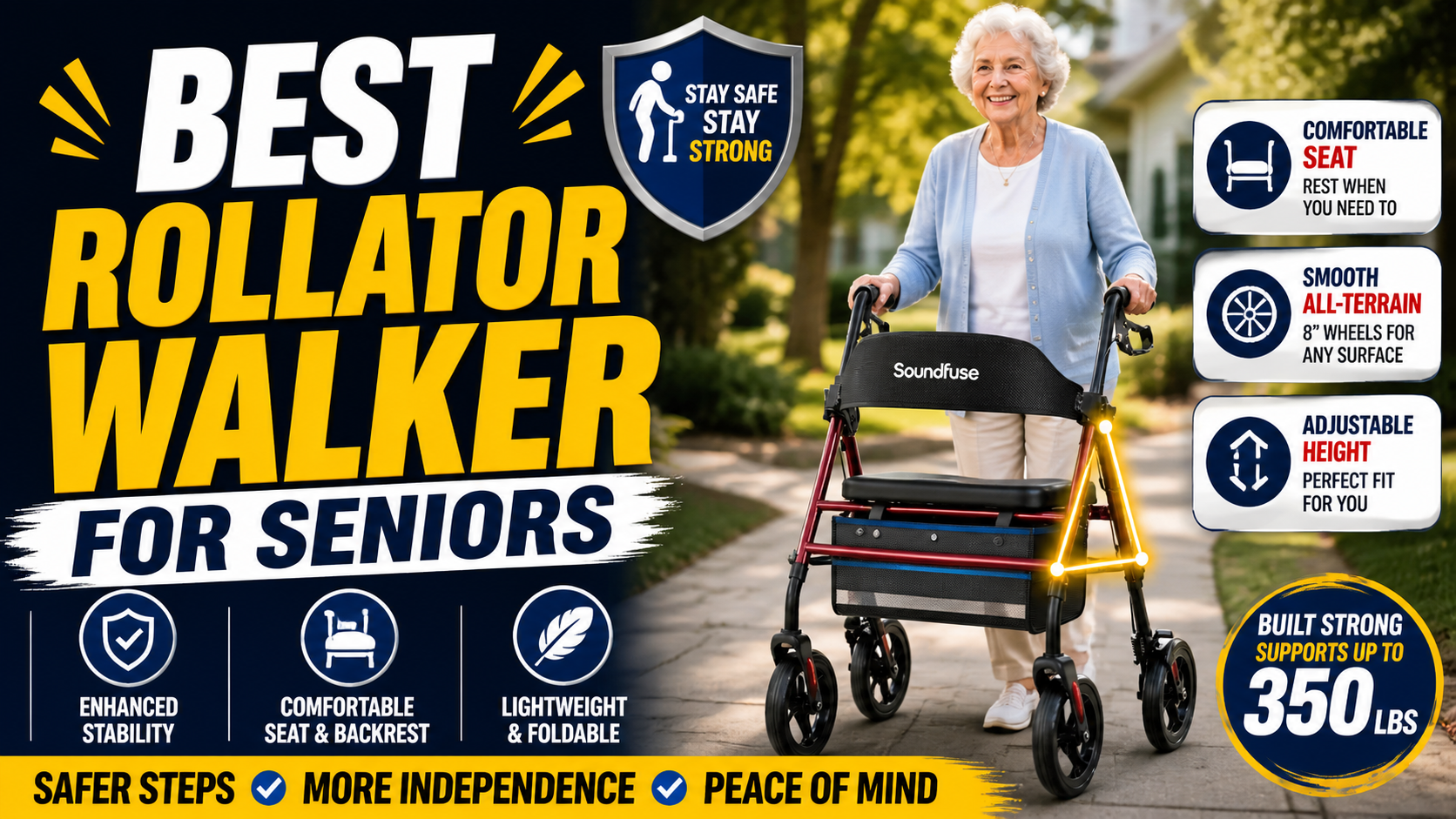
There’s a meaningful difference between a walking cane and a rollator walker — and understanding it helps you make the right choice for the right situation. A cane adds one additional point of contact. A rollator provides bilateral support, a stable frame to hold onto, built-in seating for rest breaks, and storage for daily essentials. For someone whose mobility and balance needs have progressed beyond what a cane comfortably manages, a rollator is a genuinely different category of support.
Used correctly and chosen well, a rollator extends the range of independent movement — longer walks, more confidence on varied terrain, the ability to rest when needed without finding somewhere to sit — in ways that directly support independent living and quality of life.
This review covers the SOUNDFUSE rollator walker — all-terrain 8-inch wheels, ergonomic arc seat, double support bar, dual height adjustable and foldable — and everything worth knowing before buying.
→ See the SOUNDFUSE Rollator Walker on Amazon
Rollator vs. Walking Cane vs. Standard Walker — Choosing the Right Aid
The right mobility aid depends on the specific mobility and balance situation. Here’s an honest framework for choosing.
Walking cane — appropriate when balance has changed noticeably but one additional ground contact point provides adequate support. For moderate balance challenges on familiar terrain. Our review of the best walking cane for seniors covers the option we recommend.
Standard walker — appropriate when bilateral support is needed but continuous forward movement without lifting is manageable. No wheels — requires lifting with each step. More stable than a rollator for some people, less versatile.
Rollator walker — appropriate when bilateral support is needed, when walking distances are meaningful, when terrain varies, and when the ability to rest without finding a chair matters. The wheeled design allows natural forward movement without lifting. The seat allows rest breaks on demand. For active seniors who need more than a cane but want to maintain meaningful mobility, a rollator is often the ideal solution.
If you’re uncertain which is appropriate, a physical therapist can assess your specific situation and make an evidence-based recommendation. This is worth pursuing specifically rather than guessing — the right aid used correctly is dramatically more effective than the wrong one.
What to Look for in a Rollator Walker for Seniors
Wheel Size and Terrain Performance
Wheel size directly determines where the rollator can go. Small wheels — 5 to 6 inches — handle smooth indoor surfaces but struggle on outdoor terrain, grass, gravel, and uneven pavement. Larger wheels — 8 inches and above — handle varied terrain reliably, which matters enormously for seniors who want to walk outdoors and not just indoors.
If the rollator is going to be used exclusively indoors on smooth floors, smaller wheels are adequate. If outdoor use is part of the plan — and for most active seniors it should be — 8-inch wheels are the minimum worth considering.
Seat Height and Ergonomics
The seat needs to be at the right height for comfortable sitting and for safe standing from the seat. Too low and standing becomes a significant effort requiring substantial leg strength. Too high and the legs dangle uncomfortably when seated. Adjustable seat height accommodates different users and allows fine-tuning to your specific body proportions.
Seat width matters for comfort during rest breaks — a seat that’s too narrow is uncomfortable for extended sitting. Backrest support adds meaningful comfort for rest breaks where the user wants to sit and wait rather than just pause briefly.
Handle Height Adjustability
Handle height is as important for a rollator as height is for a cane. Handles too low force a stoop that throws off posture and balance. Too high and the arms are elevated awkwardly, reducing stability. Correct handle height allows a slight elbow bend with relaxed shoulders when standing and gripping naturally.
Braking System
A rollator without reliable brakes is unsafe — the wheels provide no automatic resistance and the user needs the brakes to stop, to slow on inclines, and to lock when sitting down or standing up. Loop brakes — the standard for most quality rollators — are operated by squeezing handles and lock when pushed down. The brake mechanism needs to be operable with the grip strength typical of the intended user.
Foldability and Storage
A rollator that doesn’t fold can’t go in a car, can’t be stored compactly, and can’t travel. Foldability is essentially non-negotiable for a rollator that will be used outside the home. The folding mechanism should be simple enough to operate in one or two steps without requiring significant strength or dexterity.

The SOUNDFUSE Rollator Walker — Full Review
SOUNDFUSE Rollator Walker With Seat — 8″ All-Terrain Wheels, Double Support Bar, 16″ Ergonomic Arc Seat, Dual Height Adjustable and Foldable
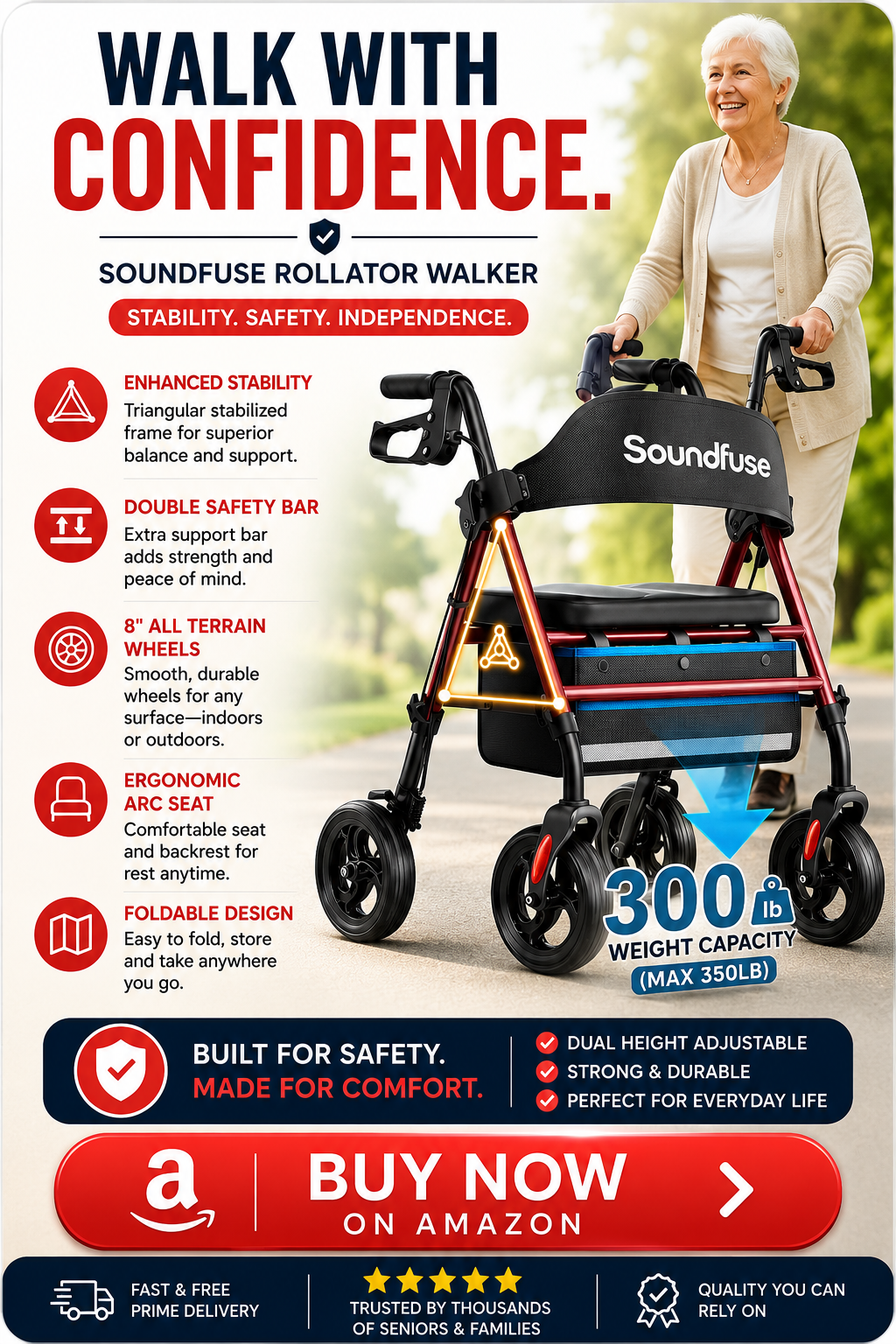
The SOUNDFUSE addresses the specifications that matter most for real-world rollator use — large all-terrain wheels, a generous ergonomic seat with backrest, dual height adjustment for both handles and frame, and a foldable design that travels and stores practically.
→ Check current price and availability on Amazon
The 8-inch all-terrain wheels are the standout feature for outdoor use. Eight-inch wheels handle the varied terrain that matters for real-world mobility — outdoor pavement, slight inclines, grass edges, parking lot transitions, and the uneven surfaces that are simply part of navigating the world outside the home. A rollator with small wheels that struggles outdoors limits the user to indoor use — significantly reducing the independence and activity benefits that make a rollator worth using in the first place.
The double support bar adds meaningful structural rigidity. A rollator frame that flexes or feels unstable under the user’s weight creates anxiety rather than confidence. The double support bar construction gives the SOUNDFUSE a solid, trustworthy feel that users who have tried less robust rollators notice immediately.
The 16-inch ergonomic arc seat with backrest is one of the most practical features. The arc shape distributes weight comfortably across a wider contact area than a flat seat. At 16 inches wide it accommodates a range of body sizes comfortably. The backrest transforms brief rest stops into genuinely comfortable seated pauses — allowing longer outings with periodic rest rather than limiting activity to what can be completed without sitting.
Dual height adjustment — both handle height and overall frame height — allows precise configuration for the specific user rather than a compromise position. Getting handle height exactly right for your body makes a meaningful difference in posture, stability, and comfort during use.
The foldable design collapses for car trunk storage, apartment storage, and travel. The fold mechanism is straightforward enough to operate without significant grip strength — important for users with arthritis or reduced hand strength.
→ Get the SOUNDFUSE Rollator Walker on Amazon
Using a Rollator Correctly
A rollator used incorrectly provides limited benefit and can contribute to posture problems or instability. Here’s correct technique.
Handle Height
Stand upright in your normal walking posture with arms hanging naturally. Handles should reach approximately wrist crease height. When gripping the handles in walking position there should be a slight — 15 to 20 degree — bend at the elbow. Adjust before regular use and verify the position feels natural and stable.
Walking Posture
Walk upright — resist the tendency to lean forward onto the rollator. The rollator supports balance but walking with excessive forward lean shifts the center of gravity forward in ways that actually reduce stability and create posture problems over time. Keep the rollator close to the body rather than pushing it far ahead.
Using the Brakes
Apply brakes before sitting down on the seat — always. A rollator with unlocked wheels on a slight incline can roll forward when weight is applied to the seat. Lock the brakes, confirm the rollator is stable, then sit. Reverse the sequence when standing — confirm brakes are locked, push up to standing, then release brakes.
On Inclines
Apply light brake pressure going downhill to control speed rather than allowing the rollator to roll freely. Going uphill, lean slightly into the rollator and use a shorter stride. If an incline feels challenging, take it slowly and rest at the top if needed.


Rollator Walker and the Complete Mobility Picture
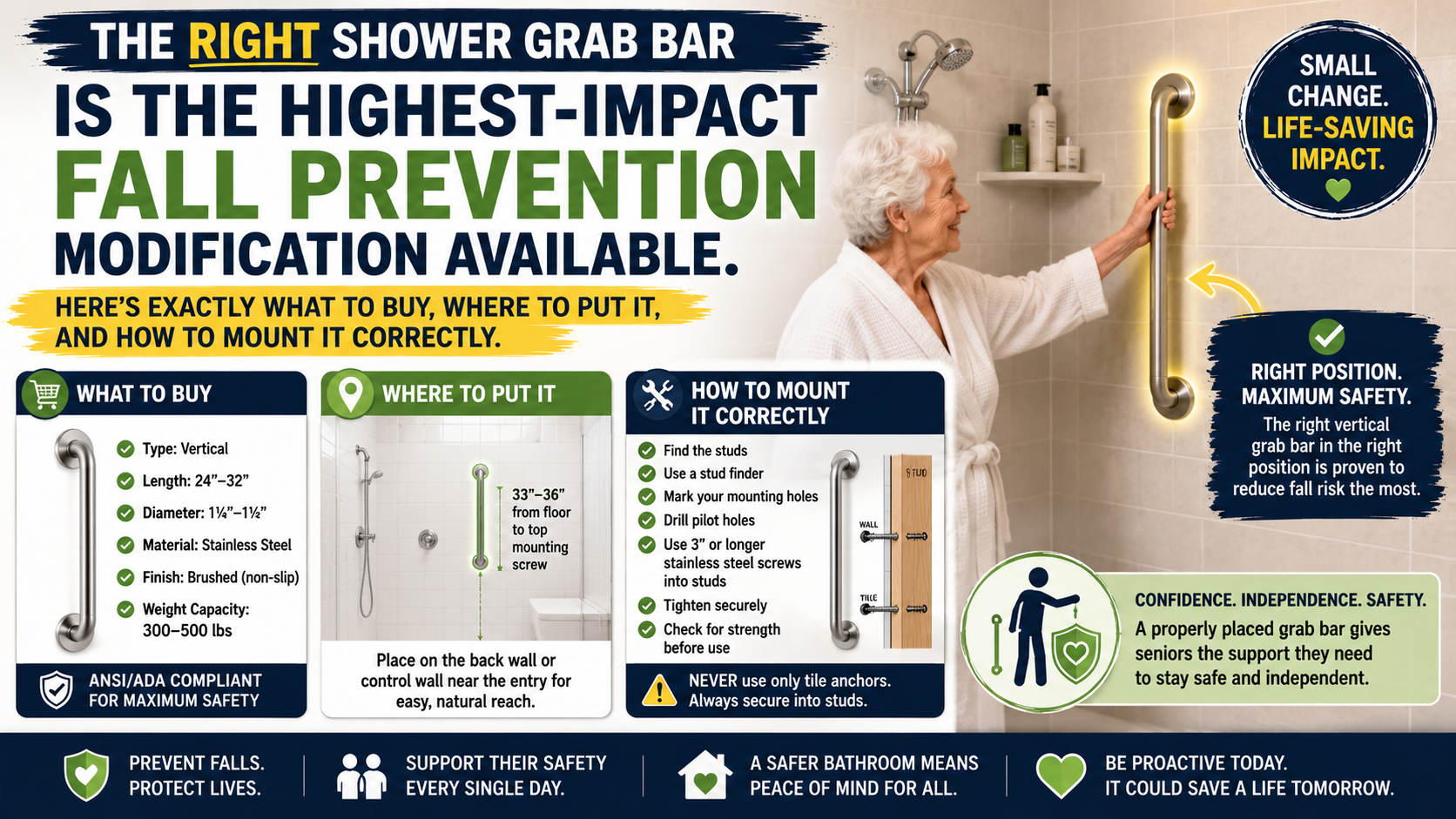
A rollator addresses outdoor and indoor mobility — the range of movement and physical activity that sustains both physical health and quality of life. It works alongside home safety modifications that address the specific fall risks inside the home.
For the complete home fall prevention picture our guide on fall prevention tips at home covers every modification worth making. Our guide on tips for balance problems covers the exercise interventions that complement mobility aid use.
And for fall detection coverage during rollator walks — outdoors where falls can happen far from home — the SecuLife Smartwatch provides automatic fall detection and GPS tracking that alerts family members immediately wherever a fall occurs.
→ Get the SOUNDFUSE Rollator Walker on Amazon
Frequently Asked Questions
How is a rollator different from a standard walker?
A standard walker has no wheels and must be lifted with each step — providing maximum stability but slower movement. A rollator has wheels that roll forward continuously, allowing a more natural walking gait. Rollators also have seats for rest breaks. The choice depends on whether the user can safely manage a rolling device — a physical therapist can advise on which is appropriate.
What weight capacity does the SOUNDFUSE support?
Check the current product listing for the specific weight capacity. Most quality rollators in this category support 300 pounds or more. Verify the capacity against the user’s weight before purchasing.
Can the rollator be used on carpet?
Yes — 8-inch wheels handle carpet and low-pile rugs without significant difficulty. Thick carpet or high-pile rugs create more rolling resistance but are generally manageable. The rollator works on hard floors, carpet, and outdoor surfaces.
Does Medicare cover rollator walkers?
Medicare Part B covers rollator walkers as durable medical equipment when prescribed by a physician and deemed medically necessary. A physician’s prescription documenting the medical need is required. Coverage typically includes 80% of the Medicare-approved amount after the deductible. Check with your specific Medicare plan for current coverage details.
How do I know if I need a rollator vs. a cane?
A cane is appropriate when one additional point of ground contact provides adequate stability. A rollator is appropriate when bilateral support is needed, when walking distances are meaningful, or when the ability to rest during activity matters. If you’re unsure, request a physical therapy assessment — this is exactly the kind of question physical therapists answer as part of mobility and fall risk evaluation.
More Miles, More Independence
A well-chosen rollator used consistently extends the range of independent movement that’s possible — longer walks, more destinations, more activity — in ways that directly support both physical health and quality of life. The SOUNDFUSE delivers the all-terrain capability, ergonomic seating, and structural integrity that make it a reliable choice for real-world daily use.
→ Order the SOUNDFUSE Rollator Walker on Amazon — check current price and read customer reviews

About the Author
Tom Garrett spent eight years as an EMT and several more as a caregiver for his father, navigating mobility aid choices under real-world conditions. He writes for Elder Safety Guide with a focus on practical guidance that helps people make confident decisions about mobility and safety.